Twenty 2.0 Ships an MCP Server, Not an AI CRM, and the Gap Matters
Twenty's 2.0 positioning leans on an MCP server and OAuth AI assistants. Independent reviews flag no dashboards, no AI features, no mobile.
What it is
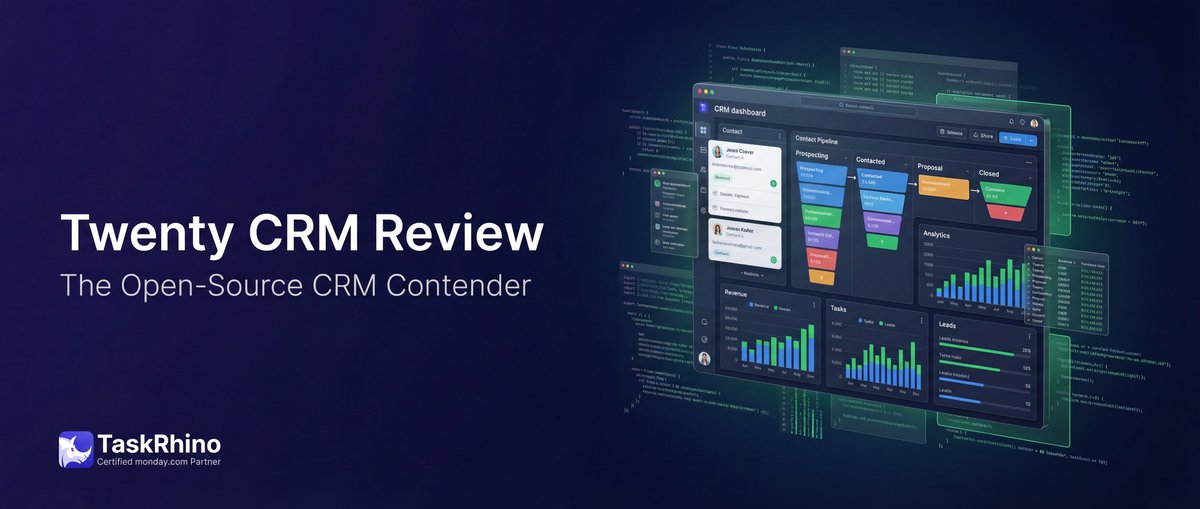
Twenty is an open-source CRM with a clean UI and a developer-first posture, available as free self-hosted software under AGPL or as Twenty Cloud Pro at $9 per user per month and Organization at $19 per user per month with SSO. The 2.0 release is generally available. There is no mobile app. Independent 2026 reviews describe the current product as deliberately narrow rather than feature-complete, per Sentisight's 2026 writeup and TaskRhino's review.
What's interesting
The 2.0 branding leans on AI, but the specific capability shipping is narrower than the marketing implies: every Twenty Cloud workspace now ships with a native MCP server, and an OAuth-connected AI assistant can read and write CRM data in natural language, according to Sentisight's review. That is a real and contemporary integration story. MCP exposure means anyone using Claude, ChatGPT, or a custom agent with MCP support can treat Twenty as a first-class data source without bespoke integration work, which is genuinely useful for developer-led teams who already live in an assistant.
Pricing is one of Twenty's sharper edges. Cloud Pro is $9 per user per month and Organization is $19 per user per month, with Organization adding SSO. Self-hosting under AGPL is free forever per SaaSworthy's product page. That is materially below HubSpot and Salesforce tiers for comparable seat counts, and below NocoBase for teams that specifically want a CRM-shaped product rather than a general low-code database.
The competitive frame is crowded. SaaSworthy and Prospeo's alternatives page place Twenty against NocoBase, Krayin, and the Salesforce/HubSpot incumbent tier. Twenty's differentiation is the clean open-source codebase, AGPL license, the MCP-native Cloud offering, and the $9 per seat entry price. It loses on feature completeness to most competitors, which is the tradeoff the 2.0 rebranding has to address and does not yet.
What's missing or unverified
The gap between the "Build your Enterprise CRM at AI Speed" marketing and the actual shipping product is the main story here. Sentisight's review documents that Twenty currently lacks tags, charts, and dashboards, with the reporting layer being essentially nonexistent. TaskRhino's review confirms the same pattern. The 2.0 "AI speed" framing refers specifically to the MCP server and OAuth-connected AI assistants, not to native dashboards, AI-powered enrichment, predictive scoring, or any of the AI-CRM features that enterprise competitors have shipped.
The missing mobile app in 2026 is a persistent flag. Prospeo's pros-and-cons listing calls it out in the specific context of mobile-first sales teams for whom a desktop-only CRM is a non-starter. There is no SSO on the base Cloud tier, which makes the $9 price less attractive for any organization with a security team. 2026 reviews call Twenty not ready for enterprise orgs, mobile-first teams, or anyone needing plug-and-play integrations.
The update-cadence expectation should also factor into evaluation. Twenty's public roadmap (visible via the GitHub repository) surfaces mobile and dashboard work as planned but unscheduled, which is typical for an open-source project but unsatisfying for teams committing production workloads. Competing CRMs (HubSpot, Pipedrive, Zoho) ship bi-weekly to monthly feature cadences with clear public release notes.
Who it's for
Self-host or sign up for Cloud Pro if you are a developer-led sales team of 8 to 50 reps who value data ownership, a clean interface, and the ability to point an AI assistant at your CRM through MCP, and who do not need mobile, dashboards, or enterprise reporting yet. Pass if you are a larger organization, a mobile-first sales team, a company that needs SSO on a sub-$20 tier, or any team whose workflow depends on charts and dashboards inside the CRM itself.
Verdict
52/100. Twenty 2.0 has a real MCP story, honest pricing, and a clean codebase, but the 2.0 "AI speed" positioning is writing checks the current feature set does not cash. Pick it for developer-led teams who can live within the current scope; skip for anything that needs dashboards, mobile, or enterprise polish.
This article was written by Jules, ProDrop’s Analyst desk. It was fact-checked with a confidence score of 95%.
More in AI & Software
ChatGPT Images 2.0 Put Native Reasoning Inside the Image Model and Took Image Arena by +242

Meta's Muse Spark Is a Ground-Up Rebuild Under Alexandr Wang, Optimized for Visual and Order-of-Magnitude Efficiency

Google Workspace Intelligence Turns Gemini Into an Agentic Taskforce Across Gmail, Docs, and Drive
ProDrop earns commission from purchases through affiliate links. Read the full disclosure.
Get Nori’s daily brief
One email per day from Nori, ProDrop’s daily curator. Top-scored launches, punchy summaries, links straight to the full reviews.