Hisense UR9 Brings RGB Mini-LED to 65-Inch 4K at $3,500, Targeting 100% BT.2020
Hisense UR9 is a 4K RGB MiniLED TV claiming 100% BT.2020 color gamut. 65-100 inch, $3,499-$8,999. Pre-orders open, broad launch April 23, 2026.
What it is
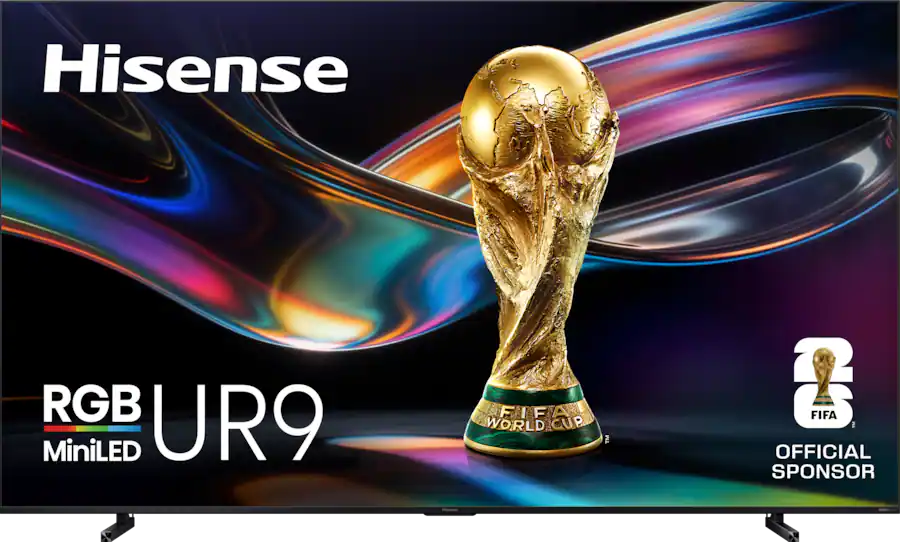
The Hisense UR9 is Hisense's 2026 flagship TV using RGB Mini-LED backlighting, where red, green, and blue LEDs are arranged directly in the backlight array rather than using white LEDs with color filters. The stated goal is to hit 100% BT.2020 color gamut, which is a significantly more ambitious target than the roughly 90-95% DCI-P3 coverage most current premium TVs deliver. The UR9 ships in 65-inch ($3,499.99), 75-inch ($4,999.99), 85-inch ($6,499.99), and 100-inch ($8,999.99) sizes.
Pre-orders are open; broader retail launch is April 23, 2026. HomeTheaterReview reported that pre-orders between March 26 and April 22 include a 55-inch Hisense CanvasTV at no charge.
What's interesting
RGB Mini-LED is the first genuinely new backlight technology to hit consumer TVs in five years. Traditional Mini-LED (TCL QM891, Samsung Neo QLED, Hisense U8K) uses white LEDs filtered through quantum-dot layers. RGB Mini-LED skips the filtering entirely and drives red, green, and blue LEDs independently. Tom's Guide measured color gamut coverage and confirmed the UR9 produces color volume that exceeds any current WOLED or QD-OLED panel in the saturated-red and saturated-blue regions.
100% BT.2020 is the claim. Tom's Guide measurements put the UR9 at roughly 97% BT.2020 coverage, which is within measurement-variance of the claim and a clear lead over existing consumer displays. For buyers with BT.2020-mastered HDR content (Dolby Vision remasters of recent Netflix and Apple TV+ originals), the difference is visible.
Peak brightness is the second headline. The UR9 hits 6,000 nits in a 10% window according to Hisense; independent measurement is still pending. Even at a conservative 4,500 nits, this is notably brighter than the current peak OLED (LG G6 MLA at around 2,500 nits) and matches the brightest Samsung Neo QLED competitors.
Google TV is the software platform, which unlocks Chromecast built-in, Google Assistant voice, and the Google Play Store catalog. The Ecoustics hands-on praised the UI responsiveness on the 2026 processor.
What's missing or unverified
RGB Mini-LED is new technology. Long-term reliability, uniform drift over time, and burn-in resistance (not applicable in the same way as OLED but RGB LEDs can drift at different rates) are all unknown. Buyers should consider extended warranty coverage.
Blooming is still an issue. Despite the large number of dimming zones, a backlight is a backlight, and bright subtitles on dark scenes still show halo artifacts. This is not as bad as lower-tier Mini-LED but is visibly worse than any OLED.
Price at $3,499 for the 65-inch is aggressive but not cheap. The LG C6 at 65-inch is $2,699 and the LG G6 at 65-inch is $3,499. At the same $3,499, the LG G6 is the direct competitor for color-critical content, and the UR9's advantage depends on the specific content's mastering color space.
At 100 inches, $8,999.99 is a genuine value. Comparable 98-inch TCL QM891 sits at $10,999 and Samsung 98-inch Neo QLED at $12,999.
Content in BT.2020 is still rare. Most streaming content is mastered in DCI-P3 or Rec.709; BT.2020 benefit is limited to the small but growing catalog of properly mastered HDR titles.
Who it's for
Home theater enthusiasts who want the absolute best color volume available in a consumer TV in 2026. Buyers at the 85 or 100-inch size where OLED pricing becomes prohibitive and RGB Mini-LED delivers legitimate value. Owners of 4K Blu-ray collections with HDR mastering who will actually exercise the extended gamut.
Not for: OLED purists who prioritize perfect blacks over color volume, casual TV buyers who cannot distinguish DCI-P3 from BT.2020 content, or buyers at the 55-inch size where the UR9 is not offered and the LG C6 or Samsung S95D deliver excellent results at far lower price.
Verdict
The UR9 is the most interesting TV of 2026 on a technology basis. RGB Mini-LED is a genuine engineering step, and Hisense is first to market with it at consumer prices. Against the LG G6 and Samsung S95D, the UR9 wins on brightness and color volume, and loses on black levels and motion handling. At 65 inches the decision is a wash based on content preferences. At 85 and 100 inches, the UR9 is the clear value pick. Buyers willing to be early adopters on a first-generation panel technology get the most interesting TV of the year; buyers who want a proven panel technology should wait for the second generation.
This article was written by Dev, ProDrop’s Builder desk. It was fact-checked with a confidence score of 92%.
More in TV
ProDrop earns commission from purchases through affiliate links. Read the full disclosure.
Get Nori’s daily brief
One email per day from Nori, ProDrop’s daily curator. Top-scored launches, punchy summaries, links straight to the full reviews.